Friday, December 2, 2016

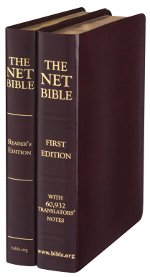
The NET Bible

I would like to introduce you to a new translation of the Bible that I have discovered, called the NET Bible. The website for it states:

"The NET Bible (New English Translation) is a completely new translation of the Bible with 60,932 translators’ notes! It was completed by more than 25 scholars – experts in the original biblical languages – who worked directly from the best currently available Hebrew, Aramaic, and Greek texts. Turn the pages and see the breadth of the translators’ notes, documenting their decisions and choices as they worked."

"The translators’ notes make the original languages far more accessible, allowing you to look over the translator’s shoulder at the very process of translation. This level of documentation is a first for a Bible translation, making transparent the textual basis and the rationale for key renderings (including major interpretive options and alternative translations)."

"This unparalleled level of detail helps connect people to the Bible in the original languages in a way never before possible without years of study of Hebrew, Aramaic, and Greek. It unlocks the riches of the Bible’s truth from entirely new perspectives."

According to Brian H. Edwards in his book, From Vulgate to Vulgar, "It is constantly updated from input by scholars and others on the latest research results in linguistics and interpretation. The notes are intended both at a technical level for pastors, teachers and students of Hebrew, Aramaic, and Greek who are interested in the grammatical, syntactical and text-critical details, and for general readers."

"The NET Bible aims to be ‘accurate, readable, and elegant’ and strives for ‘faithfulness to the original biblical texts while at the same time seeking to attain accuracy in terms of current English style'. One of its general principles is to indicate in the notes a more literal rendering, and to be gender-accurate rather than gender-inclusive."

As with any translation, it is not without its flaws. One thing I do not like about it is that it uses the expression "bad luck" in Ecclesiastes 5:14, where it says, "Then that wealth was lost through bad luck; although he fathered a son, he has nothing left to give him." They have translated the Hebrew word "inyan" as luck, but luck is not taught in the Bible at all. In fact, luck is connected with lucifer, which you can easily verify if you do some research. I find that many believers are accustomed to using the term luck, even though it is unbiblical. I prefer instead the way the NIV translates this verse with the expression, "some misfortune", or even the NASB that translates it as "bad investment." I have not read the entire NET Bible, but this was just one point on which I disagree with the translation, and I want to be clear that I do not promote the use of the term "luck." Nevertheless, the translation gives the alternate English words for "inyan" in the notes, so this helps to address the issue I have with it.

Therefore, I still recommend it overall. Let me encourage you to investigate this new translation, which is available at the following sites:

http://netbible.org
https://lumina.bible.org/bible/
http://netbible.com

Author's note: If you enjoyed this post, you may also like the other posts in this blog available through the Home page, such as The Bible is the Word of God, Read the Bible for All Its Worth!, All Scripture must be fulfilled, The Uniqueness of God's Word, The Bible Never Fails, and Bible Reading Plan. You may also access my complete blog directory at "Writing for the Master."
_________________________________________________

Len Lacroix is the founder of Doulos Missions International.  He was based in Eastern Europe for four years, making disciples, as well as helping leaders to be more effective at making disciples who multiply, developing leaders who multiply, with the ultimate goal of planting churches that multiply. His ministry is now based in the United States with the same goal of helping fulfill the Great Commission. www.dmiworld.org.
Saturday, October 1, 2016

The Uniqueness of God's Word

Unlike any other book, the Bible is unique, since it is the Word of God. Let’s look at some of the unique characteristics that make the Word of God different from all others.

As our main text, let's consider Hebrews 4:12-13, which says: “For the word of God is living and active and sharper than any two-edged sword, and piercing as far as the division of soul and spirit, of both joints and marrow, and able to judge the thoughts and intentions of the heart. And there is no creature hidden from His sight, but all things are open and laid bare to the eyes of Him with whom we have to do.”

It is Living and Active
First, we know that “the Word of God is living and active” (Heb 4:12). Here are some examples of what it means for the Word to be living and active.

It is alive! The words of men are merely dead words, whether they are found in a newspaper, history book, political speech, comic book, or legal contract. They are not alive. But the Word of God is alive. It is called “the word of life” (1 Joh 1:1).

It speaks. It is not just black words on white pages. It actually speaks. It comes forth from God’s mouth. Jesus said, "It is written, 'Man shall not live on bread alone, but on every word that proceeds out of the mouth of God.'" (Mat 4:4).

It is what God says, not only what He once said. It remains in the present tense, so that thousands of years after it was spoken, it is still speaking to us today.

“He again fixes a certain day, Today,’ saying through David after so long a time just as has been said before, ‘Today if you hear his voice, do not harden your hearts.’ (Heb 4:7)

It convicts, judges and penetrates deep within us “…piercing as far as the division of soul and spirit, of both joints and marrow, and able to judge the thoughts and intentions of the heart.”

It bears fruit after its own kind, just as any organic seed or organism does. Jesus said, "Now the parable is this: the seed is the word of God.” (Luk 8:11). He said, "The sower sows the word…And those are the ones on whom seed was sown on the good soil; and they hear the word and accept it and bear fruit, thirty, sixty, and a hundredfold." (Mar 4:14,20).

If you want to have good fruit in your life, then read lots of Scripture, believe it, and put it into practice. When you do that, the very things you read in Scripture will be seen coming forth in your life. Whatever you put into your mind and your heart, that is what you are going to become. The seed of the Word that you heard will take root inside of you and bear good fruit.

The Word is the seed by which we have been born again. In our natural birth we were conceived from human, perishable seed. But in the second birth, the seed is the imperishable Word of God. While natural seed may perish, this seed will never pass away. Peter said, “For you have been born again not of seed which is perishable but imperishable, that is, through the living and enduring word of God.” (1Pe 1:23)

It does not return to Him empty, void, or without results. God spoke through the prophet Isaiah saying, “As the rain and the snow come down from heaven, and do not return to it  without watering the earth and making it bud and flourish, so that it yields seed for the sower and bread for the eater, so is my word that goes out from my mouth: It will not return to me empty, but will accomplish what I desire and achieve the purpose for which I sent it” (Is 55:10-11, NIV). It accomplishes God’s desires and achieves His glorious purpose.

It is eternal. “Your word, Lord, is eternal; it stands firm in the heavens.” (Ps 119:89, NIV). Peter quoted the prophet Isaiah saying, “For all flesh is like grass, and all its glory like the flower of grass. The grass withers, and the flower falls off, but the word of the Lord endures forever. And this is the word which was preached to you” (1Pe 1:24-25).

It gives light. The psalmist said, “Your word is a lamp to my feet And a light to my path…The unfolding of Your words gives light.” (Psa 119:105,130a). Peter wrote, “So we have the prophetic word made more sure, to which you do well to pay attention as to a lamp shining in a dark place, until the day dawns and the morning star arises in your hearts.” (2Pe 1:19)

It generates faith. Paul said, “So faith comes from hearing, and hearing by the word of Christ.” (Rom 10:17).

It originates from God. Speaking of the Scriptures, Peter wrote, “But know this first of all, that no prophecy of Scripture is a matter of one's own interpretation, for no prophecy was ever made by an act of human will, but men moved by the Holy Spirit spoke from God.” (2Pe 1:20-21). The inspired writers of Scripture spoke from God as the Holy Spirit carried them along.

It IS God. The Scripture is very clear about this. It’s an indisputable fact.” In the beginning was the Word, and the Word was with God, and the Word was God.” (Joh 1:1). It cannot be denied that the Word is God.

The Word is a divine Person, not merely a set of letters and punctuation arranged together and printed on a page. That is why the Scripture refers to the Word as “He.” It says, “He was in the beginning with God…And the Word became flesh, and dwelt among us, and we saw His glory, glory as of the only begotten from the Father, full of grace and truth” (Joh 1:2,14).

Therefore, the Word of God is interactive. These days interactive websites and software are very popular, because we like to interact with what we are seeing and reading. Likewise, we can interact with the Word. God speaks and we respond, and this process continues back and forth between us through His Word and by the Spirit.

The Word is God’s Son. As I have just quoted, John said, “as of the only begotten from the Father” (Joh 1:14). The apostle Paul wrote, “God, after He spoke long ago to the fathers in the prophets in many portions and in many ways, in these last days has spoken to us in His Son, whom He appointed heir of all things, through whom also He made the world.” (Heb 1:1-2). While God spoke through the prophets in the past, now the Word has come to us through His own Son.

The Word sustains and upholds all things. “And He is the radiance of His glory and the exact representation of His nature, and upholds all things by the word of His power. When He had made purification of sins, He sat down at the right hand of the Majesty on high…” (Heb 1:3)

These examples I have just cited illustrate how the Word is living and active, making it one of a kind.

It is Sharp!
Secondly, we know that “the Word of God is… sharper than any two-edged sword, piercing to the division of soul and of spirit, of joints and of marrow…” (Heb 4:12). Here are some examples of what it means for the Word to be sharper than any two-edged sword.

It penetrates right through anything. A two-edged sword is sharpened on both sides of the blade, and a sharp one can easily cut through a person’s flesh. But even the sharpest two-edged sword cannot pass through everything. For example, it cannot penetrate through steel or thick rock. Yet the Word of God is sharper than any two-edged sword. It divides soul from spirit, and joints from marrow.

When a surgeon uses a sharp scalpel to cut a patient open, he can do open heart surgery with it, whereby the chest is opened and a saw is used to cut the breast bone, so that the heart can be operated on. But even the sharpest scalpel cannot divide the human soul from the spirit. This is something that only the Word of God can do, cutting easily through even those things that are invisible.

We know to be careful when handling sharp knives, such as those used in the kitchen, because we respect sharp knives and understand they can easily cut us badly. However, the Word of God must be handled even more carefully that any sharp knife.

“For this reason we must pay much closer attention to what we have heard, so that we do not drift away from it.” (Heb 2:1)

“See to it that you do not refuse Him who is speaking. For if those did not escape when they refused him who warned them on earth, much less will we escape who turn away from Him who warns from heaven.” (Heb 12:25)

Total Exposure
Finally, since the Word of God is living, active, and very sharp, it exposes everything. Nothing is hidden from it. “And there is no creature hidden from His sight, but all things are open and laid bare to the eyes of Him with whom we have to do.” (Heb 4:13). It doesn’t matter if you go to the bottom of a deep mine shaft and hide there, God will still know every thought you have and every word you speak, as well as the motives and intentions of your heart. In other words, He even knows the attitude behind your thoughts and words.

“For your ways are in full view of the Lord, and he examines all your paths.” (Pro 5:21, NIV).

Putting it All Together
Based on what we have learned from Scripture about the Word of God, we know it is alive! It speaks. It convicts, judges and penetrates deep within us. The Word is the seed by which we have been born again. It bears fruit after its own kind. It does not return to Him empty, void, or without results, but accomplishes God’s desires and achieves His glorious purpose. It is eternal. It gives light. It generates faith. It originates from God. It IS God. It cannot be denied that the Word is God. The Word is a divine Person. The Word of God is interactive. The Word is God’s Son. The Word sustains and upholds all things. It is so sharp that it penetrates right through anything, dividing soul from spirit, and joints from marrow. The Word of God exposes everything. In light of all these wonderful, unique characteristics of the Word, it is truly unlike any other word or message or book. Therefore, it must be handled even more carefully that any sharp knife.

When you open the Bible to read it, pray first and ask the Lord to speak to you through it, and expect Him to do so. As you read, listen to what He is saying to you, believing and accepting it. Interact with Him, praising Him for what He says to you, responding to Him, claiming His promises to you, and repenting for sin whenever He exposes it to you.. May we once again have a reverence for the Word of God, instead of treating it so casually as is so common these days. Let's humble ourselves and tremble at His Word. The Lord declares, "But to this one I will look, To him who is humble and contrite of spirit, and who trembles at My word." (Isa 66:2b).

Attributions: Most Scripture quotations taken from the NASB, unless otherwise noted. Other Scriptures taken from The Holy Bible, New International Version® NIV®.

Author's note: If you enjoyed this post, you may also like the other posts in this blog available through the Home page, such as The Bible is the Word of God, Read the Bible for All Its Worth!, All Scripture must be fulfilled and The Bible Never Fails. You may also access my complete blog directory at Writing for the Master.


Do You Want to Know Him?
If you want to know Jesus personally, you can. It all begins when you repent and believe in Jesus.  Do you know what God's Word, the Bible says?

“Jesus came into Galilee, preaching the gospel of God, and saying, ‘The time is fulfilled, and the kingdom of God is at hand; repent and believe in the gospel.’” (Mar 1:14b-15).  He preached that we must repent and believe.

Please see my explanation of this in my post called "Do You Want to Know Jesus?"
_________________________________________________

Len Lacroix is the founder of Doulos Missions International.  He was based in Eastern Europe for four years, making disciples, as well as helping leaders to be more effective at making disciples who multiply, developing leaders who multiply, with the ultimate goal of planting churches that multiply. His ministry is now based in the United States with the same goal of helping fulfill the Great Commission. www.dmiworld.org.

Bible Reading Plan

The psalmist said, "How can a young person stay on the path of purity? By living according to your word. I seek you with all my heart; do not let me stray from your commands. I have hidden your word in my heart that I might not sin against you. Praise be to you, Lord; teach me your decrees. With my lips I recount all the laws that come from your mouth. I rejoice in following your statutes as one rejoices in great riches. I meditate on your precepts and consider your ways. I delight in your decrees; I will not neglect your word." (Ps 119:9-16, NIV).

Let me encourage you today to read lots of God's Word. But it won't happen accidentally. You will need to plan to do so. A good starting point is to read 25 to 30 chapters per week. In order to do this, you will need to pace yourself and ensure you read at least 4 to 5 chapters per day. Delight in God's Word and hide it in your heart. Seek Him with all your heart. Stay on the path of purity by living according to His Word.

There are 929 chapters in the Old Testament and 260 chapters in the New Testament for a total of 1,189 chapters in the Bible. If you read 4 to 5 chapters per day, you will easily finish reading through the whole Bible in around 264 days or about 37 weeks, which is around 8 to 9 months. It's about 100 hours of reading, if you take about 5 minutes per chapter, but I encourage you to take as long as you need to meditate on it, so the Lord can speak to you.

Please find the Bible Reading Chart at this link, which you can download and print, in order to help you mark off the chapters in each book of the Bible as you read them. I gave this to my children, and one of my daughters used it to help her read through the Bible in about two months. Therefore, it doesn't have to take you 9 months to a year to read through it. Depending on how motivated you are, and how much time you spend at it each day, you can finish it much sooner. Don't neglect His Word.

Attributions: Scriptures taken from The Holy Bible, New International Version® NIV®, unless otherwise noted.

Author's note: If you enjoyed this post, you may also like the other posts in this blog available through the Home page, such as The Bible is the Word of God, Read the Bible for All Its Worth!, The Uniqueness of God's Word, All Scripture must be fulfilled, and The Bible Never Fails. I also recommend Keeping a Prayer Journal, Life Transformation Groups, How to Start an LTG, Doulos Training School, and Scripture Alone.You may also access my complete blog directory at Writing for the Master.

Do You Want to Know Him?
If you want to know Jesus personally, you can. It all begins when you repent and believe in Jesus.  Do you know what God's Word, the Bible says?

“Jesus came into Galilee, preaching the gospel of God, and saying, ‘The time is fulfilled, and the kingdom of God is at hand; repent and believe in the gospel.’” (Mar 1:14b-15).  He preached that we must repent and believe.

Please see my explanation of this in my post called "Do You Want to Know Jesus?"
_________________________________________________

Len Lacroix is the founder of Doulos Missions International.  He was based in Eastern Europe for four years, making disciples, as well as helping leaders to be more effective at making disciples who multiply, developing leaders who multiply, with the ultimate goal of planting churches that multiply. His ministry is now based in the United States with the same goal of helping fulfill the Great Commission. www.dmiworld.org.

Tuesday, May 31, 2016

Unidentified Descendant of Jacob Who Went to Egypt

Jacob blesses Ephraim and Manasseh
Let's take a look at a very interesting passage found in Genesis, which initially appears to have an error or contradiction, but upon further examination, it reveals the miraculous involvement of God's hand in preserving His people Israel.

According to Gen 46:8, “These are the names of the sons of Israel (Jacob and his descendants) who went to Egypt.” If you count the names, you will arrive at a different number than the totals indicated at the end of the passage. It is off by one person. In order to reconcile this, we need to identify that person.

I suggest reading Genesis 46 before reading the rest of this article, since it will make more sense to you. Now let me explain the apparent discrepancies and the questions they raise.

Females Included?
You may be wondering if the females were counted or not, since the passage refers to these listed people as “the sons of Israel” (Gen 46:8). The designation of "sons" seems to exclude females. However, Asher’s daughter Serah is included in the biblical count of sixteen children born to Jacob by Zilpah (Gen 46:17). That makes it very clear that females were included.

The question of whether Dinah (daughter of Jacob) is counted requires a bit more explanation. She is listed as a direct descendant of Jacob, and at first glance, she does appear to be counted as one of the thirty-three sons and daughters of Jacob from Leah (Gen 46:15). But then if you count up only the male descendants of Leah, they come to thirty-three, which seems to agree with the count of thirty-three in verse 15. However, since Er and Onan died in the land of Canaan (Gen 46:12), they are not counted among those who “went to Egypt” with Jacob (Gen 46:8). Moreover, since verse 15 specifically states that the thirty-three descendants of Leah include both “sons and daughters of Jacob,” it is certain that Dinah was included. By adding Dinah to the count of those who “went to Egypt” with Jacob, the total of Leah’s descendants only comes to thirty-two, not the stated thirty-three! Who is the missing person? This is the missing piece of the puzzle, and the crux of this article, which I will come to in a moment.

Having proven from Scripture that both Serah and Dinah were included in the count, we know that females who were direct descendants of Jacob were certainly counted. Therefore, we can easily deduce that the counts in this passage included both male and female direct descendants of Jacob, who went to Egypt, even though the passage opens by describing them as “the sons of Israel who went to Egypt” (Gen 46:8). I have also proven that the missing person is a descendant of Jacob through Leah.

Seventy Names Listed?
The passage concludes by stating, “All those who went to Egypt with Jacob—those who were his direct descendants, not counting his sons’ wives—numbered sixty-six persons. With the two sons who had been born to Joseph in Egypt, the members of Jacob’s family, which went to Egypt, were seventy in all.” (Gen 46:26-27). This is one of three passages in the Old Testament, which states that seventy of Jacob's descendants went down to Egypt (cf., Ex 1:1,5; Deut 10:22). Let's look at the names listed in this passage:

1.    Reuben
2.    Hanok
3.    Pallu
4.    Hezron
5.    Karmi
6.    Simeon
7.    Jemuel
8.    Jamin
9.    Ohad
10.   Jakin
11.   Zohar
12.   Shaul
13.   Levi
14.   Gershon
15.   Kohath
16.   Merari
17.   Judah

Er (died in Canaan, not included in count)
Onan (died in Canaan, not included in count)

18.    Shelah
19.    Perez
20.    Zerah
21.    Hezron
22.    Hamul
23.    Issachar
24.    Tola
25.    Puah
26.    Jashub
27.    Shimron
28.    Zebulun
29.    Sered
30.    Elon
31.    Jahleel
32.    Dinah (daughter of Jacob)
33.    Gad
34.    Zephon
35.    Haggi
36.    Shuni
37.    Ezbon
38.    Eri
39.    Arodi
40.    Areli
41.    Asher
42.    Imnah
43.    Ishvah
44.    Ishvi
45.    Beriah
46.    Serah (sister)
47.    Heber
48.    Malkiel
49.    Benjamin
50.    Bela
51.    Beker
52.    Ashbel
53.    Gera
54.    Naaman
55.    Ehi
56.    Rosh
57.    Muppim
58.    Huppim
59.    Ard
60.    Dan
61.    Hushim
62.    Naphtali
63.    Jahziel
64.    Guni
65.    Jezer
66.    Shillem
67.    Joseph (already in Egypt)
68.    Manasseh (already in Egypt)
69.    Ephraim (already in Egypt)
70.    (Unidentified person)

As you can see, there are only sixty-nine names listed, and one seems to be unidentified, because there were supposed to be seventy, according to verse 27. Yet here are the total number of descendants reckoned to each of Jacob's wives in the passage:

Sons and Daughters from Leah = 33 (Gen 46:15)
Children from Zilpah = 16 (Gen 46:18)
Sons from Rachel = 14 (Gen 46:22)
Sons from Bilhah = 7 (Gen 46:25)
______________________
Subtotal = 70

Subtract Er and Onan (Leah’s descendants), who did not make it alive to Egypt = - 2
______________________
Subtotal = 68

Add Ephraim and Manasseh born in Egypt = 2
______________________
Total = 70

Who is the unidentified person that brings the total of Jacob's descendant's to seventy?

If you look at my subtotal above, the names of the direct descendants of Jacob who went to Egypt came to sixty-eight, before you add Ephraim and Manasseh. So why does verse 26 state “sixty-six persons,” when sixty-eight names are listed after omitting Er and Onan? If we remove only the name of Joseph, who is one of the sixty-eight names listed above in the passage, we arrive at the odd number of sixty-seven, not the sixty-six stated in verse 26. So who is the missing person that must be omitted to bring the number to sixty-six? This person would have to have been in Egypt already, and yet be a descendant of Jacob when he arrived there.

Riddle Solved
We arrive at the only possible answer to this when we more closely consider Asenath, Joseph’s wife, as a possible candidate for the missing person. While Scripture refers to her as “daughter of Potiphera, priest of On” (Gen 41:45; 46:20), could she have been a direct descendant of Jacob? Hebrew tradition held that she was born to Jacob’s daughter Dinah when Shechem son of Hamor the Hivite raped her (Gen 34:2). It was believed that an Egyptian priest adopted Dinah’s baby, similar to the way that Pharoah’s daughter adopted Moses.

While the versions of this legend do not agree with each other, and some versions contradict the Bible on certain details, one thing the various Hebrew versions have in common is that Asenath was the daughter of Dinah and Shechem. There is also a Christian version recorded in an apocryphal book that depicts Asenath as an orphan and Potiphera as her foster father. Of course, the basis for our faith must be the Word of God alone, not the traditions of men, so we cannot put our trust in traditions.

However, if there is any truth at all to these legends with regard to Asenath's true parents, and if the priest of On was merely her foster father, then it resolves two questions in Genesis 46. In addition to identifying the seventieth descendant of Jacob who went to Egypt in verse 27, it also solves the puzzle I mentioned in the previous section as to who the missing person is among the thirty-three “sons and daughters of Jacob” through Leah that went to Egypt. By subtracting Er and Onan from the list of thirty-three sons, and then adding Dinah and Asenath, we get the total of thirty-three “sons and daughters of Jacob” through Leah in verse 15. Who else besides Asenath could be the one missing person who meets all the criteria in both verses 15 and 27?

Furthermore, it cannot be that Asenath was merely included among the seventy people in verse 27 merely because she was Joseph’s wife, if she were not one of Jacob's descendants. Otherwise, Jacob’s wives and his son's wives would have also been listed. But they were explicitly excluded, according to verse 26. The count in Genesis 46 specifically includes only the male and female direct descendants of Jacob who went to Egypt.

Putting it All Together
Therefore, the sixty-six direct descendants of Jacob who went with him to Egypt did not include Joseph and his wife Asenath, along with their sons Ephraim and Manasseh, who were already in Egypt when he arrived. By adding these additional four people (pictured in the above illustration) to the other sixty-six, it brings the total to seventy people. This provides a strong case to substantiate the Hebrew belief that Asenath was one of Jacob’s direct descendant’s. It also proves that there is no error in this passage of Scripture.

Finally it shows the amazing providence of God, who preserved Asenath in Egypt, so that no member of Jacob’s family would be lost. God moved the heart of Pharaoh to give her to Joseph as his wife (Gen 41:45), when he promoted him to ruler of Egypt. Not only did it ensure that none of Jacob’s offspring was lost, it also enabled Joseph to marry within his family, thus fulfilling the strict orders that Abraham, Isaac, and Jacob had been given to marry within their own family, and not take a wife from among the Canaanites.

If Joseph had actually married a true Egyptian woman, then his sons Ephraim and Mannaseh, who were born to her, would not be legitimate heirs of the Promised Land. But they were in fact listed among the twelve tribes of Israel (Gen 48:5-6; Dt 34:2; Num 1:32-33; Rev 7:5-8), and Jacob blessed them and Joseph on his deathbed before he blessed his other eleven sons (Gen 48:9-22). And when the Israelites possessed the land of Canaan, Ephraim and Manasseh received their own territories as directed by Jacob and Moses (Josh 14:3-4). Truly God’s miraculous hand was involved in enabling Joseph to marry his niece.

[1] Graves, Robert & Patai, Raphael, Hebrew Myths (New York: Greenwich House, 1964), p. 237. See also Ginzberg, op. cit., II: 38.

Attribution notice: Most Scripture quotations taken from the NASB. Painting of Jacob blessing Ephraim and Manasseh while Joseph and Manasseh look on is used here merely as an illustration for educational and commentary purposes only, according to the FAIR USE Act. No copyright violation intended.

Author's note: If you enjoyed this post, you may also like the other posts in this blog available through the Home page, such as The Bible is the Word of God, All Scripture must be fulfilled, and The Bible Never Fails. You may also access other articles on the Home page for this blog, as well as my complete blog directory at "Writing for the Master."

Do You Want to Know Him?
If you want to know Jesus personally, you can. It all begins when you repent and believe in Jesus.  Do you know what God's Word, the Bible says?

“Jesus came into Galilee, preaching the gospel of God, and saying, ‘The time is fulfilled, and the kingdom of God is at hand; repent and believe in the gospel.’” (Mar 1:14b-15).  He preached that we must repent and believe.

Please see my explanation of this in my post called "Do You Want to Know Jesus?"
_________________________________________________

Len Lacroix is the founder of Doulos Missions International.  He was based in Eastern Europe for four years, making disciples, as well as helping leaders to be more effective at making disciples who multiply, developing leaders who multiply, with the ultimate goal of planting churches that multiply. His ministry is now based in the United States with the same goal of helping fulfill the Great Commission. www.dmiworld.org.

Thursday, May 5, 2016

Oral Account of Creation from Adam to Abraham


In this study, I would like to show how the true account of creation was accurately passed down by word of mouth from Adam to Abraham.

Let's begin by looking at the relationships between Adam and his family line. In doing this, you will be able to draw many conclusions, as well as see how the true and accurate account of the creation was preserved by Adam up until the time of Noah. 

Adam lived to be 930 years old (Gen 5:5). The flood occurred 1,656 years after Adam was created, so Adam died 726 years before the flood.

Noah was born 1,056 years after Adam was created. Since Noah was 600 years old when the flood began (Gen 7:6), that means he was born 126 years after Adam died.

Since Noah was born when his father Lamech was 182 years old, Lamech would have known Adam or at least been alive during Adam’s lifetime.  In fact, Lamech would have been 56 years old when Adam died.

Since Lamech was born when his father Methuselah was 187 years old, then 56 years later, at the time when Adam died, Methuselah was 243 years old. 

126 years after the death of Adam, when Noah was born, Methuselah was 369 years old.  Since the flood came 600 years after Noah’s birth, that would make Methuselah 969 years old when the flood came.

Adam's Generations
In the table below, I have shown the generations from Adam to Noah (Gen 5:1-32), along with the year of birth and year of death for each person, according to the number of years from the creation of Adam (Hebrew years).

Name Age at First Son's Birth Year of Birth Age at Death Year at Death Age at Adam's Death
Adam 130 0 930 930 930
Seth 105 130 912 1042 800
Enosh 90 235 905 1140 695
Kenan 70 325 910 1235 605
Mahalalel 65 395 895 1290 535
Jared 162 460 962 1422 470
Enoch 65 622 365 987 308
Methuselah 187 687 969 1656 243
Lamech 182 874 777 1651 56
Noah    500 1056    950    2006

Adam to Noah Chart
The chart below displays the data from the table above. Each yellow bar represents the life of the person named to the left, beginning with Adam at the bottom. Notice how all the bars above Adam's bar run concurrent with his life, except for Noah, showing that all these men except for him were contemporaries of Adam. You can see that the bar for Adam's life ends before the line that marks the year 1,000, and the bar for Noah's life begins after that same line. This shows that there was a gap between Adam's death and Noah's birth.

Conclusions about Methuselah
Methuselah was alive for 243 years of Adam’s life.  He and Adam were contemporaries. During that time, he would have heard the story of creation perhaps directly told by Adam. Methuselah’s father was Enoch, who walked with God for 365 years and was no more (Gen 5:24). We know that Methuselah died at the age of 969, so he died the same year the flood happened. He was the oldest man that ever lived and he died right before the flood came. He was alive for the entire period that Noah was building the ark.

Conclusions about Lamech
Lamech was 187 years old at the time of his son Noah’s birth and he died 590 years later at the age of 777, just 5 years before the flood.  Lamech would have been alive for most of the period when Noah was building the ark. Since Lamech was 56 years old when Adam died, he too would have heard the true account of creation perhaps directly told by Adam. Noah would have heard the creation story in stereo from his father Lamech and grandfather Methuselah, who both heard it directly from Adam. Methuselah and Lamech provided an unbroken, dual connection between Adam and Noah. Thus all things were established by the testimony of two witnesses. This preserved the true and accurate account of the creation, so that Noah was able to carry that with him and pass it on to his sons into the new world after the flood.

Incidentally, it is also hard to imagine how Lamech and Methuselah would not have been encouraging Noah as he was building the ark, since they were alive at that time.

Walking with God
I would like to highlight those who walked faithfully with God. One of them was Enoch. Scripture says, "Enoch walked with God; and he was not, for God took him." (Ge 5:24). It does not say he died, which is how it describes the end of life for all the others in Adam's line. He did not die. God took him! In the book of Hebrews, it says, "By faith Enoch was taken up so that he would not see death; and he was not found because God took him up; for he obtained the witness that before his being taken up he was pleasing to God." (Heb 11:5). What a glorious witness he obtained! He was pleasing to God.

"Noah's Preaching Scorned" by Harry Anderson
The other person that Scripture says walked with God was Noah. It says, "Noah was a righteous man, blameless in his time; Noah walked with God." (Gen 6:9; 7:5).  It also says, "Noah found favor in the eyes of the Lord." (Gen 6:8). Noah did all that God commanded him (Gen 6:22). When God said to build the ark, Noah obeyed and built it according to the pattern God gave him. When God said to gather the animals, Noah gathered them. When God said to enter the ark (Gen 7:1), Noah obeyed and entered the ark (Gen 7:13). When God said to go out of the ark (Gen 8:16), Noah went out of the ark (Gen 8:18). The book of Hebrews says, "By faith Noah, being warned by God about things not yet seen, in reverence prepared an ark for the salvation of his household, by which he condemned the world, and became an heir of the righteousness which is according to faith." (Heb 11:7). I hope this encourages you to walk by faith with God, too, and to do what God says in Scripture.

Noah's Generations
In the table below, I have shown the generations from Noah to Abraham (Gen 11:10-32), along with the year of birth and year of death for each person, according to the number of years from the creation of Adam (Hebrew years).

Name Age at First Son's Birth Year of Birth Age at Death Year at Death Age at Noah's Death
Noah 500 1056 950 2006 950
Shem 100 1556 600 2156 450
Arphaxad 35 1656 438 2094 350
Shelah 33 1691 433 2127 315
Eber 34 1724 464 2188 282
Peleg 33 1758 242 2000
Reu 32 1791 239 2030 215
Serug 32 1823 232 2055 183
Nahor 29 1855 148 2003
Terah 70 1884 205 2089 122
Abraham 100 1954 175 2129 52

Noah to Abraham Chart
The chart below displays the data from the table above. Each yellow bar represents the life of the person named to the left, beginning with Noah at the bottom. Notice how all the bars above Noah's bar run concurrent with his life, showing that all these men were contemporaries of Noah.


Inspiration and Transmission of Scripture
While it is true that all Scripture is inspired by God (2 Tim 3:16), and that the writers received what they wrote through supernatural, divine inspiration, the accuracy of biblical history was preserved by eyewitness testimony. The Gospels are another example of this in that the apostles, who accompanied Jesus all the time He went in and out among them, until He was taken up from them into heaven, were reliable eyewitnesses of His resurrection (Ac 1:21-22). Matthew and John, who wrote the gospels that bear their names, and Peter, who is believed to be the source of Mark's gospel, saw the majestic glory of Christ firsthand, and heard the voice that came from heaven when they were with Him on the sacred mountain (Joh 1:14; 2 Peter 1:16-18).
Luke, who was not one of the Twelve apostles, began his gospel by saying, "Inasmuch as many have undertaken to compile an account of the things accomplished among us, just as they were handed down to us by those who from the beginning were eyewitnesses and servants of the word, it seemed fitting for me as well, having investigated everything carefully from the beginning, to write it out for you in consecutive order, most excellent Theophilus; so that you may know the exact truth about the things you have been taught." (Luk 1:1-4).

Even though Luke was inspired by God to write the gospel, he also investigated everything carefully from the beginning, compiled eyewitness testimonies, and wrote out the exact truth in consecutive order. Likewise, when he wrote the book of Acts, he did the same thing, except that he himself was also one of the eyewitnesses to the things he wrote, regarding the apostle Paul's ministry, since he was one of his traveling companions. Therefore, we know that God's supernatural work of inspiration is also accompanied by the supernatural way he oversees the accuracy of the transmission process through eyewitness accounts.

Putting it All Together
Through this study, we have seen that the ancient men of old who lived before the flood were contemporaries of Adam, except for Noah, who was born after Adam died. It helps us to see that Adam would have had a relationship with his descendants up to the ninth generation.

Noah began a new generation separated from the life of Adam that would bring hope and the knowledge of God into a new world. He also carried with him the true account of the creation from Adam, as well as his own eyewitness account of God destroying all of creation, because of the wickedness of mankind, and graciously saving Noah and his family -- eight in all -- just as God said He would do. All that God said He would do was fulfilled, just as all Scripture must be fulfilled.

Likewise, after the flood, Noah lived to see his descendants in the line of Shem up to the eleventh generation -- all the way up to Abraham. He was a contemporary with all of those, and they all lived to see his death, except for Peleg and Nahor.  Abraham's father Terah was 122 years old at the time of Noah's death and Abraham was 52. So they may have heard the account of the creation and the flood directly from Noah, along with all the other key events that happened before and after the flood. 

Ancient history was carried forward for 2,000 years primarily by two main persons with firsthand, eyewitness accounts, namely Adam and Noah. That's excellent record-keeping on God's part! And all of the descendants of these two men, who lived contemporaneously with them, provided an excellent backup of that information, along with their own valuable contributions of what they personally witnessed.

Moreover, like Noah, Shem his son lived before, during, and after the flood. Just like his father, Shem helped to bridge the generations of Adam across the flood and he lived to the ripe old age of 600 years old! He was 450 years old when Noah died. And he outlived all of his descendants up to and including Abraham, except for Eber (Shem died in 2156 and Eber died 32 years later). So just as Noah, Shem was able to transmit to all of these descendants of his the accurate accounts of the creation and the flood, as well as all of the other events before and after the flood up until his death. He died 27 years after Abraham died! His blessed family line became the one through which Abraham and all the Hebrews descended, and the line through which David and his Son, Jesus Christ came (Lk 3:21-38).

This shows the amazing care that God took to preserve the accurate accounts of those important events from early human history, so that they could be passed down to us later by Moses in what has come to be known as the first book of Moses or Genesis. Don't ever doubt God's supernatural ability to preserve His Word.

Attribution notice: Most Scripture quotations taken from the NASB. "Noah's Preaching Scorned" by Harry Anderson.

Author's note: If you enjoyed this post, you may also like the other posts in this blog available through the Home page, such as All Scripture must be fulfilled, The Bible Never Fails, and The Evil Nephilim Giants. You may also access other articles on the Home page for this blog, as well as my complete blog directory at "Writing for the Master."

Do You Want to Know Him?
If you want to know Jesus personally, you can. It all begins when you repent and believe in Jesus.  Do you know what God's Word, the Bible says?

“Jesus came into Galilee, preaching the gospel of God, and saying, ‘The time is fulfilled, and the kingdom of God is at hand; repent and believe in the gospel.’” (Mar 1:14b-15).  He preached that we must repent and believe.

Please see my explanation of this in my post called "Do You Want to Know Jesus?"
_________________________________________________

Len Lacroix is the founder of Doulos Missions International.  He was based in Eastern Europe for four years, making disciples, as well as helping leaders to be more effective at making disciples who multiply, developing leaders who multiply, with the ultimate goal of planting churches that multiply. His ministry is now based in the United States with the same goal of helping fulfill the Great Commission. www.dmiworld.org.

Saturday, August 8, 2015

Read the Bible for All Its Worth!

Today I would like to share some guidelines for you that will help you read your Bible for all its worth. 

Step One 
Open in Prayer (but also remain in an attitude of prayer throughout the study).

Don't read the Bible like a newspaper, magazine, or any other book. Don't rely on your own understanding. Approach it with reverence and awe, beginning with prayer for help from God.

The psalmist prayed, "Open my eyes that I may see wonderful things in your law." (Ps 119:18, NIV).

As the proverb says, "Trust in the Lord with all your heart and lean not on your own understanding." (Pr 3:5, NIV).

As the Holy Spirit spoke through the prophet Isaiah: “'For my thoughts are not your thoughts, neither are your ways my ways,' declares the Lord. 'As the heavens are higher than the earth, so are my ways higher than your ways and my thoughts than your thoughts.'" (Is 55:8-9, NIV)

God's thoughts are higher than ours, and we cannot understand them except by the Spirit. As the apostle said:

"These are the things God has revealed to us by his Spirit. The Spirit searches all things, even the deep things of God. For who knows a person’s thoughts except their own spirit within them? In the same way no one knows the thoughts of God except the Spirit of God...The person without the Spirit does not accept the things that come from the Spirit of God but considers them foolishness, and cannot understand them because they are discerned only through the Spirit...for, 'Who has known the mind of the Lord so as to instruct him?' But we have the mind of Christ." (1 Cor 2:10-12,16, NIV).

Humble yourself before God and admit that you cannot understand the Scriptures unless He enables you to do so. Ask for wisdom, insight, and understanding. Ask Him to show you the whole Truth and nothing but the Truth. Ask for the Holy Spirit to teach you, and have an open mind that loves the Truth. When you do, the Holy Spirit will guide you into all Truth (Jn 16:13). 

Step Two
Read the Bible Passage prayerfully, using the following questions for discovery:

1. What is the context (location, historical, time, period, person speaking, Biblical context, etc.)?

Examples:

The time of Moses.
Before the flood.
In the beginning at the creation.
While the Israelites were in exile in Babylon.
The birth of Jesus.
The baptism of Jesus.
After the resurrection of Jesus.
Paul’s second missionary journey.

2.    What do you observe in this passage? Be specific.

Possible answers (your answers are not limited to these, but they are intended to give you examples of the types of observations to make):

Identify key words you observed
Interrogate the passage with 5 W's and H (i.e., who, what why, where, when, how?)
Terms of conclusion (e.g., Therefore, So, For this reason, So then, etc)
Terms of contrasts (e.g., For, Because (for the reason explained next), Since, etc)
Expressions of time (Before, After, During, While, When, Meanwhile, Months, Years, Hour, etc.)
Terms of comparison: simile, metaphor, and hyperbole (e.g., As, Like, So that, In order that, That. Not all uses of "that" but often those at the beginning of a sentence or clause)

Once you have completed making your observations, you can move on to interpretation step.

3.    What does the passage mean? 
Use any one of the questions below to help you interpret the passage:

What is one of the things this passage is meant to teach us?
What did it mean to its original hearers or the people it was written to?
What is a lesson it teaches?

Step Three
Apply the meaning of the passage by asking the following question:

How does this (the meaning you described in question #3 of Step Two) apply to our lives today?

Examples:
“We should not fight or argue with each other.”
"We should strive earnestly to enter the kingdom of God."

Once you determine how the passage applies to our lives today, then you need to put it into practice. As Jesus said:

“Therefore everyone who hears these words of mine and puts them into practice is like a wise man who built his house on the rock. The rain came down, the streams rose, and the winds blew and beat against that house; yet it did not fall, because it had its foundation on the rock. But everyone who hears these words of mine and does not put them into practice is like a foolish man who built his house on sand. The rain came down, the streams rose, and the winds blew and beat against that house, and it fell with a great crash.” (Mt 7:24-27, NIV).

And James said, "Anyone who listens to the word but does not do what it says is like someone who looks at his face in a mirror and, after looking at himself, goes away and immediately forgets what he looks like." (James 1:23-24, NIV). I'll touch on this more in the next section.

At this point, I'd like to mention that as you read the Word, when the Holy Spirit convicts you of something you are doing that you should not be doing, or something you are not doing that you should be doing, you should repent immediately. That should be your response, asking the Lord to forgive you and help you do His will. Jesus said, “Not everyone who says to me, ‘Lord, Lord,’ will enter the kingdom of heaven, but only the one who does the will of my Father who is in heaven." (Mt 7:21, NIV).

Praying as You Read
Finally, I want to emphasize that not only is it important to pray before you begin reading, but to pray as you read. Pray both with the Spirit (i.e., in the Spirit) and with your understanding (1 Cor 14:15). Each verse you read is an opportunity to interact with the Lord verbally out loud, as He is speaking to you through it. Each verse is an opportunity for you to do one of the following: praise the Lord for what is in the verse, thank the Lord for it, repent of some sin the verse convicts you of (as mentioned already), pray for the Lord to keep you from some wrongdoing that may be referred to in the verse (1 Jn 5:17), claim some promise found in the verse, pray some prayer explicitly found in the verse, or pray for someone else according to the verse. If you adopt this practice, your Bible reading will not only be a time of reading, but a time of prayer, too.

When you are finished with your time of Bible reading, pray and ask the Lord to add His blessing to the reading of His Word and to implement it in your life, so that you may be a doer of it, and not only a hearer (as mentioned already).  

Common Mistakes
I would like to mention some common mistakes to avoid when reading the Bible.

Taking Things Out of Context
One mistake people make is to take things out of context. Remember that every text has a context.  That immediate context will be the verses before and after it. The wider context will include the chapters before and after it. And the broadest context includes the whole Bible. Scripture interprets Scripture. So remember that no verse can be made to contradict the rest of the Bible.

Reading into the Text
Another common mistake is reading into the text.  This is when you come to the Bible with your idea, you assume it is supporting your idea.  The same happens when you come to the Bible with your pastor's idea, or what your Church believes, or your denomination, and when you read the Scriptures, you think those verses uphold what you have been taught to believe.  That has led many people into error, so please don't do it. Instead of reading your meaning into the text, you should be letting the text speak for itself, and draw out of it the meaning that God originally intended.

Allegorizing Scripture
It's common for people to allegorize passages of the Bible, when that is not what was intended by God. This is when you assign a figurative or spiritual meaning to something rather than the literal meaning. Of course, if the original speaker or writer of the Bible passage clearly indicates that they are speaking figuratively, then you should understand it the same way (e.g., Jn 10:6; 16:29; Gal 4:24-25). For example, if it is a parable, then understand it that way. But be careful you don't take the liberty on your own to do this with things that are meant to be taken literally. You should always begin by assuming the text was meant to be taken literally, unless it is impossible to do so or the text itself says it is figurative.

When reading the hard sayings of Jesus, because they are hard, people often assume He meant something other than what He said. But always keep in mind that Jesus said what He meant, and He meant what He said.

Incorrectly Assigning Meanings
Another error is to take the meanings explicitly assigned to the parts of one parable and assume that the same meaning always applies in every parable.  An example would be that while oil is often used to represent the Holy Spirit, don't assume that is necessarily so in every passage where oil is mentioned. If you did that, it would lead to false interpretations. For example, then you would incorrectly assume that the shrewd manager in Luke 16:5-6 was trying to settle with his master's customers on a price for the gift of the Holy Spirit, and that he was commended for doing so. You need to understand that in each parable, the characters and objects may represent something different than what they represented in another parable.

Using the Apostles to Interpret Jesus 
I think another mistake is using the words of the apostles in their inspired writings to interpret what Jesus meant in His teachings. This is especially dangerous when it is used to soften or lessen the severity of something Jesus said. Be careful with this! Jesus is the foundation upon which the apostles and prophets built. Therefore, you should use the words and teachings of Jesus to interpret the writings of the apostles and prophets. For more on this, see my article, The Law of Christ.

Putting it All Together
So always begin with prayer and continue in prayer as you follow the steps of observation, interpretation, and application in that sequence. Always have an open mind that loves the Truth. At the same time, you should avoid common mistakes like taking things out of context, reading your own meaning into the text, allegorizing, and incorrectly assigning meanings to things in parables based on other parables. I trust that in following this approach and asking these questions, you will see things you would not have seen otherwise. You will receive more from God in His Word than ever before. The passage will open up to you and you will find the wonderful treasures buried within in its pages. You will know the Truth and the Truth will set you free. Then don't forget to close in prayer and do what the Word says.

Attributions: Some elements of this approach have been derived from what I learned from the late Dr. Charles Holman in his courses at the Regent University graduate School of Divinity, called, Principles of Bible Study I and II.  And a book I found very helpful was How to Read the Bible for All Its Worth by Gordon Fee and Douglas Stuart. Scriptures taken from The Holy Bible, New International Version® NIV®, unless otherwise noted.

Author's note: If you enjoyed this post, you may also like the other posts in this blog available through the Home page, such as The Bible is the Word of God, The Uniqueness of God's Word, All Scripture must be fulfilled and The Bible Never Fails. You may also access my complete blog directory at "Writing for the Master."

Do You Want to Know Him?
If you want to know Jesus personally, you can. It all begins when you repent and believe in Jesus.  Do you know what God's Word, the Bible says?

“Jesus came into Galilee, preaching the gospel of God, and saying, ‘The time is fulfilled, and the kingdom of God is at hand; repent and believe in the gospel.’” (Mar 1:14b-15).  He preached that we must repent and believe.

Please see my explanation of this in my post called "Do You Want to Know Jesus?"
_________________________________________________

Len Lacroix is the founder of Doulos Missions International.  He was based in Eastern Europe for four years, making disciples, as well as helping leaders to be more effective at making disciples who multiply, developing leaders who multiply, with the ultimate goal of planting churches that multiply. His ministry is now based in the United States with the same goal of helping fulfill the Great Commission. www.dmiworld.org.

Friday, July 3, 2015

Numerical Patterns in Scripture

Throughout the Word of God we see amazing and supernatural patterns in the numbers.  We don’t focus on this most of the time, since that is not the purpose for reading the Bible. We are supposed to focus on the message itself. Nevertheless, these patterns do exist and they help our faith when we see them, because we know it would be impossible for them to exist apart from the Lord’s awesome design.

You see the Bible is actually a compilation of shorter books written over a period of about 1,600 years that were later assembled together in what we call the canon of Scripture. And when the forty men, whom the Lord inspired, wrote the original manuscripts, there were no chapter or verse numbers. These were added many centuries later.  So man did not intentionally create these patterns that I am about to show you, but God saw fit that it would happen that way.

In the Beginning
The Creation of all things by God in the beginning is recorded in Genesis 1:1 and reaffirmed in the New Testament in John 1:1; and 1 John 1:1, where we learn that the Word of God was with God in the beginning and actually was God. 

“In the beginning God created the heavens and the earth.” (Gen 1:1)

“In the beginning was the Word, and the Word was with God, and the Word was God.” (Joh 1:1)

“What was from the beginning, what we have heard, what we have seen with our eyes, what we have looked at and touched with our hands, concerning the Word of Life…” (1 Jn 1:1)

Note that John also says, “All things came into being through Him, and apart from Him nothing came into being that has come into being…And the Word became flesh, and dwelt among us, and we saw His glory, glory as of the only begotten from the Father, full of grace and truth.” (Joh 1:3,14).

Also see Is Jesus God?.

The Mark of the Beast - 666
In the Word we learn that the mark of the beast is either the name of the beast or the number of his name, which is 666, and that those who take the mark will not enter the kingdom of God.  We find some interesting verses bearing those numbers in Jn 6:66 and Is 66:6. But first let me give the explanation of the mark from the apostle John’s apocalypse.

“And he causes all, the small and the great, and the rich and the poor, and the free men and the slaves, to be given a mark on their right hand or on their forehead, and he provides that no one will be able to buy or to sell, except the one who has the mark, either the name of the beast or the number of his name. Here is wisdom. Let him who has understanding calculate the number of the beast, for the number is that of a man; and his number is six hundred and sixty-six.” (Rev 13:16-18)

“Then another angel, a third one, followed them, saying with a loud voice, ‘If anyone worships the beast and his image, and receives a mark on his forehead or on his hand, he also will drink of the wine of the wrath of God, which is mixed in full strength in the cup of His anger; and he will be tormented with fire and brimstone in the presence of the holy angels and in the presence of the Lamb. And the smoke of their torment goes up forever and ever; they have no rest day and night, those who worship the beast and his image, and whoever receives the mark of his name.’ Here is the perseverance of the saints who keep the commandments of God and their faith in Jesus.” (Rev 14:9-12)

Now take a look at what happened in John 6:66.

“As a result of this many of His disciples withdrew and were not walking with Him anymore.” (Joh 6:66)

John 6:66 describes an apostasy during Jesus day when many of his disciples turned back and no longer followed Him.  We know that according to Paul’s second epistle to the Thessalonians, there will first be a great apostasy (defecting from the truth or falling away) among Christians before the man of lawlessness is revealed, whose number is 666 (Rev 13:18).

And the prophet Isaiah wrote about the sound of the Lord’s voice from His temple, as he takes vengeance on His enemies in Isaiah 66:6, which is in perfect harmony with what we have just read in Revelation about the punishment for those who take the mark of the beast -- 666.

“A voice of uproar from the city, a voice from the temple, the voice of the LORD who is rendering recompense to His enemies.” (Isa 66:6)

Now back to John’s gospel for a moment, and we see that Jesus explained to His family why His disciples withdrew and were not walking with Him anymore.

“The world cannot hate you, but it hates Me because I testify of it, that its deeds are evil.” (Joh 7:7).

And from the context we observe that right before many of Jesus’ disciples walked away from Him, He had been teaching that unless you eat the flesh of the Son of Man and drink His blood, you have no life in yourselves. He said, "He who eats My flesh and drinks My blood has eternal life, and I will raise him up on the last day. For My flesh is true food, and My blood is true drink. He who eats My flesh and drinks My blood abides in Me, and I in him. As the living Father sent Me, and I live because of the Father, so he who eats Me, he also will live because of Me. This is the bread which came down out of heaven; not as the fathers ate and died; he who eats this bread will live forever." (Joh 6:53-58).  It was that teaching which caused many disciples to leave Him.

It certainly was not the twelve disciples who withdrew and stopped walking with Jesus, but it was many other disciples.  We know this because when those disciples withdrew from Him, Jesus said to the Twelve, "You do not want to go away also, do you?" Simon Peter answered Him, "Lord, to whom shall we go? You have words of eternal life. "We have believed and have come to know that You are the Holy One of God." (Joh 6:67-69)

One last verse I would like to point out in connection with 666 is Genesis 6:6.

The LORD was sorry that He had made man on the earth, and He was grieved in His heart.” (Gen 6:6)

It says that in the days of Noah when the thoughts of all men were continually evil, the Lord was sorry that He had made man on the earth, he regretted it, and it brought pain to His heart, because of all the evil deeds men were committing, which were taking them down to hell.  This too seems to fit right in with the number of man, who was created in the sixth day, which is the number six. And it also fits in with passage about the number of the beast, which is 666.

Also see The Mark of the Beast (666) and Drifting Away.

The Mark of God
In both Revelation 9:4 and Ezekiel 9:4, it speaks about the mark (or seal) of God to protect those who are God's people:

"They were told not to hurt the grass of the earth, nor any green thing, nor any tree, but only the men who do not have the seal of God on their foreheads." (Rev 9:4)

"The LORD said to him, 'Go through the midst of the city, even through the midst of Jerusalem, and put a mark on the foreheads of the men who sigh and groan over all the abominations which are being committed in its midst.'" (Eze 9:4)

The Punishment for Sin
In both Ezekiel 18:4 and Revelation 18:4, we find a warning about the punishment for sin.

The Lord told Ezekiel that the soul who sins will die.

"Behold, all souls are Mine; the soul of the father as well as the soul of the son is Mine. The soul who sins will die.” (Eze 18:4)

The Lord explained that children would not die for the sins of their fathers, but for their own sins.  And the Lord revealed to the apostle John the need for separation from Babylon in order to avoid participating in her sins and receiving her plagues.

“I heard another voice from heaven, saying, ‘Come out of her, my people, so that you will not participate in her sins and receive of her plagues.’”(Rev 18:4).

Also see Sins That Will Keep You From Heaven, Sin and Consequence, The Dangers of Disobedience, and Angelica Zambrano Hell and Heaven.

Delivered from the Bondage of Slavery
Both Exodus 6:6 and Romans 6:6 speak about deliverance of God’s people from bondage to slavery.

The Lord told Moses, “Say, therefore, to the sons of Israel, 'I am the LORD, and I will bring you out from under the burdens of the Egyptians, and I will deliver you from their bondage. I will also redeem you with an outstretched arm and with great judgments.” (Exo 6:6)

The apostle Paul wrote about being delivered from slavery to sin when he said, “Knowing this, that our old self was crucified with Him, in order that our body of sin might be done away with, so that we would no longer be slaves to sin.” (Rom 6:6)

Also see my articles called, Having a Servant's Heart  and The Truth Set Me Free!

The Fruit of Repentance
Both Matthew 3:8 and Luke 3:8 speak of the need to bear the fruit of repentance.

"Therefore bear fruit in keeping with repentance." (Mat 3:8)

"Therefore bear fruits in keeping with repentance, and do not begin to say to yourselves, 'We have Abraham for our father,' for I say to you that from these stones God is able to raise up children to Abraham." (Luk 3:8).

Also see my article called, Repentance That Leads to Life.

He Laid Down His Life in Love
We learn from the 3:16 verse in John’s gospel and his epistle that God in His great love for the world gave His only begotten Son, who laid down His life for us in love. That’s in John 3:16 and 1 John 3:16.

“"For God so loved the world, that He gave His only begotten Son, that whoever believes in Him shall not perish, but have eternal life.” (Joh 3:16)

We know love by this, that He laid down His life for us; and we ought to lay down our lives for the brethren.” (1Jn 3:16).

Also see The Sacrifices of God and The Love of Jesus.

The Love Chapters
Most people who read their Bibles should be familiar with the love chapter in Paul the apostle's epistle to the Corinthians. First Corinthians chapter 13 is the famous love chapter, since almost every single one of its 13 verses is about love. Here is a sample you're probably familiar with:

"Love is patient, love is kind. It does not envy, it does not boast, it is not proud. It is not rude, it is not self-seeking, it is not easily angered, it keeps no record of wrongs. Love does not delight in evil but rejoices with the truth. It always protects, always trusts, always hopes, always perseveres.
Love never fails." (1 Cor 13:4-8).

But did you know that John 13 is the other love chapter in the Bible? Most of the chapter is about love and how Jesus showed the full extent of his love to His disciples by washing their feet. Here are some excerpts:

"Having loved his own who were in the world, he now showed them the full extent of his love." (Jn 13:1b).

"One of them, the disciple whom Jesus loved, was reclining next to him." (Jn 13:23).

"“A new command I give you: Love one another. As I have loved you, so you must love one another. By this all men will know that you are my disciples, if you love one another.” (Jn 13:34-35).

So it's not just a coincidence that both John 13 and 1 Corinthians 13 are about love and that 1 Corinthians 13 has a total of 13 verses.

The New Covenant
The New Covenant is cited in both Jeremiah 31:31 and Hebrews 8:8.

“’Behold, days are coming," declares the LORD, ‘when I will make a new covenant with the house of Israel and with the house of Judah,’ (Jer 31:31)

“For finding fault with them, He says, ‘Behold, days are coming, says the Lord, when I will effect a new covenant with the house of Israel and with the house of Judah;” (Heb 8:8)

What a rare coincidence that both the chapter and verse numbers match in the Old Testament reference to the New Covenant (31:31), and they also match in the New Testament reference to the New Covenant (8:8). Both passages from Jeremiah and Hebrews refer to the New Covenant in Jesus' blood, which God in His love is inviting you to enter into.

Also see The New Covenant and Law of Love in the New Testament.

No Condemnation
In both John 8:1-11 and Romans 8:1-11, we learn that there is no condemnation for the repentant soul who walks by the Spirit and not according to the sinful nature.

“But Jesus went to the Mount of Olives. Early in the morning He came again into the temple, and all the people were coming to Him; and He sat down and began to teach them. The scribes and the Pharisees *brought a woman caught in adultery, and having set her in the center of the court, they *said to Him, "Teacher, this woman has been caught in adultery, in the very act. "Now in the Law Moses commanded us to stone such women; what then do You say?" They were saying this, testing Him, so that they might have grounds for accusing Him. But Jesus stooped down and with His finger wrote on the ground. But when they persisted in asking Him, He straightened up, and said to them, "He who is without sin among you, let him be the first to throw a stone at her." Again He stooped down and wrote on the ground. When they heard it, they began to go out one by one, beginning with the older ones, and He was left alone, and the woman, where she was, in the center of the court. Straightening up, Jesus said to her, "Woman, where are they? Did no one condemn you?" She said, "No one, Lord." And Jesus said, "I do not condemn you, either. Go. From now on sin no more."] (Joh 8:1-11)

There is therefore now no condemnation to those who are in Christ Jesus, who walk not according to the flesh but according to the Spirit. But the Law of the Spirit of life in Christ Jesus has made me free from the law of sin and death. For what the law could not do, in that it was weak through the flesh, God sending his own Son in the likeness of sinful flesh, and for sin, condemned sin in the flesh; so that the righteousness of the Law might be fulfilled in us, who walk not according to the flesh but according to the Spirit. For they who are according to the flesh mind the things of flesh, but they who are according to the Spirit the things of the Spirit. For to be carnally minded is death, but to be spiritually minded is life and peace because the carnal mind is enmity against God, for it is not subject to the Law of God, neither indeed can it be. So then they who are in the flesh cannot please God. But you are not in the flesh, but in the Spirit, if the Spirit of God dwells in you. But if anyone has not the Spirit of Christ, he is none of His. And if Christ is in you, indeed the body is dead because of sin, but the Spirit is life because of righteousness. But if the Spirit of the One who raised up Jesus from the dead dwells in you, the One who raised up Christ from the dead shall also make your mortal bodies alive by His Spirit who dwells in you.” (Rom 8:1-11, MKJV).

Also see The Beauty of Brokenness, By Grace Alone and Keeping Power of God.

Prayer Promises About Asking
The Lord Jesus promised us that we would receive whatever we ask for in prayer, and these are recorded in Matthew 7:7; Luke 11:11; John 14:14; and Matthew 21: 21.

Ask, and it will be given to you; seek, and you will find; knock, and it will be opened to you.” (Mat 7:7)

“’Now suppose one of you fathers is asked by his son for a fish; he will not give him a snake instead of a fish, will he?’” (Luk 11:11)

"If you ask Me anything in My name, I will do it.”  (Joh 14:14)

“And Jesus answered and said to them, "Truly I say to you, if you have faith and do not doubt, you will not only do what was done to the fig tree, but even if you say to this mountain, 'Be taken up and cast into the sea,' it will happen.’” (Mat 21:21)

If you look at the verse immediately after Mat 21:21, the Lord said, "And all things you ask in prayer, believing, you will receive." (Mat 21:22)

Another interesting aspect about this promise is not only that the chapter and verse references are 7:7, 11:11, 14:14, and 21:21, but that in the English language, the Lord’s promise in Matthew 7:7 creates an acronym for the Word “ASK”:

Ask, and it will be given to you.
Seek, and you will find.
Knock, and it will be opened to you.

Let that encourage you and build your faith! Also see Prayer Promises.

This is That
In Acts 2 when the disciples were all baptized in the Holy Spirit on the day of Pentecost, the apostle Peter explained that this was that which the Lord prophesied through the prophet Joel. The passage quoted by Peter in Acts 2 is written in Joel 2.

“But Peter, taking his stand with the eleven, raised his voice and declared to them: ‘Men of Judea and all you who live in Jerusalem, let this be known to you and give heed to my words. For these men are not drunk, as you suppose, for it is only the third hour of the day; but this is what was spoken of through the prophet Joel: “And it shall be in the last days,” God says, “that I will pour forth of My spirit on all mankind; and your sons and your daughters shall prophesy, and your young men shall see visions, and your old men shall dream dreams; even on My bondslaves, both men and women, I will in those days pour forth of My spirit And they shall prophesy. And I will grant wonders in the sky above and signs on the earth below, blood, and fire, and vapor of smoke. Te sun will be turned into darkness and the moon into blood, before the great and glorious day of the Lord shall come. And it shall be that everyone who calls on the name of the lord will be saved.'” (Act 2:14-21)

"It will come about after this That I will pour out My Spirit on all mankind; And your sons and daughters will prophesy, Your old men will dream dreams, Your young men will see visions. Even on the male and female servants I will pour out My Spirit in those days. I will display wonders in the sky and on the earth, Blood, fire and columns of smoke. The sun will be turned into darkness And the moon into blood Before the great and awesome day of the LORD comes. And it will come about that whoever calls on the name of the LORD Will be delivered; For on Mount Zion and in Jerusalem There will be those who escape, As the LORD has said, Even among the survivors whom the LORD calls." (Joe 2:28-32).

Also see Baptized with the Spirit and Holy Fire Baptism.

Keeping the Sabbath Holy
In both Exodus 20:8 and Ac 20:8, the context is about keeping the Lord’s Day holy.

The Lord told Moses when He gave him the Ten Commandments, "Remember the Sabbath day, to keep it holy.” (Exo 20:8).

And in the early Church, they gathered on the first day of the week for worship services. Luke recorded in the book of Acts: “(7) On the first day of the week, when we were gathered together to break bread, Paul began talking to them, intending to leave the next day, and he prolonged his message until midnight. (8) There were many lamps in the upper room where we were gathered together.” (Act 20:7,8).

Moreover, it is in Jn 20:8 that we read about the apostles discovering the empty tomb on the first day of the week.  "So the other disciple who had first come to the tomb then also entered, and he saw and believed." (Jn 20:8).  However, on that particular morning, they did not gather for worship due to the fact that they did not yet understand what was happening. John says in the next two verses, "For as yet they did not understand the Scripture, that He must rise again from the dead. So the disciples went away again to their own homes." (Joh 20:9-10).  Therefore, it wasn't until later that night, after the Lord's appearances to them, that they were gathered together on the first day of the week, and the Lord came and stood in their midst (Jn 20:19).

Another interesting side note is that the Sabbath is spoken about in the Synoptic Gospels in Matthew 12, Mark 2, and Luke 6.  In these chapters, we learn about the heart of the Lord of the Sabbath, Jesus Christ.  It’s lawful to do good on the Sabbath, and we don’t observe it in the Jewish way, but we must keep it holy in honor of the Lord who rose on the first day of the week. And the chapter numbers twelve, two, and six do have a correlation with each other, since twelve divided by two equals six. Remember that God said, “Six days you shall labor and do all your work, but the seventh day is a sabbath of the LORD your God; in it you shall not do any work, you or your son or your daughter, your male or your female servant or your cattle or your sojourner who stays with you.” (Exo 20:9-10)

Also see Keeping Sundays Holy - Part I and Keeping Sundays Holy - Part II.

Tithing
In both Proverbs 3:10 and Malachi 3:10, we learn about the overflowing blessings that come to those who practice tithing.

“9 Honor the LORD from your wealth And from the first of all your produce; 10 So your barns will be filled with plenty And your vats will overflow with new wine.” (Pro 3:9-10)

“’Bring the whole tithe into the storehouse, so that there may be food in My house, and test Me now in this,’ says the LORD of hosts, ‘if I will not open for you the windows of heaven and pour out for you a blessing until it overflows.’” (Mal 3:10)

It's interesting that these verses about the overflow from giving the tithe, which means "tenth", are found in the tenth verse of these two chapters. Be sure you are giving God the whole tithe, which is the entire first ten percent of all your income, because the tithe belongs to the Lord. If you are not doing so, He considers it stealing from Him (Mal 3:8). Whatever you give above ten percent is considered offerings.

Also see Is Tithing Required for Christians? and Where Should You Give Your Tithe? 

Marriage is for Life
The apostle Paul speaks about the lifelong nature of marriage in the seventh chapters of his epistles to both the Romans and the Corinthians, and it just so happens that the seventh commandment is "Thou Shalt Not Commit Adultery",

"Or do you not know, brethren (for I am speaking to those who know the law), that the law has jurisdiction over a person as long as he lives? For the married woman is bound by law to her husband while he is living; but if her husband dies, she is released from the law concerning the husband. So then, if while her husband is living she is joined to another man, she shall be called an adulteress; but if her husband dies, she is free from the law, so that she is not an adulteress though she is joined to another man." (Rom 7:1-3)

"A wife is bound as long as her husband lives; but if her husband is dead, she is free to be married to whom she wishes, only in the Lord." (1Co 7:39)

Also see Divorce -- Three Divine Revelations.

Three-and-a-Half years
We learn about the final three-and-a-half years in the twelfth chapters of Daniel and Revelation. That’s in Daniel 12:7 and Revelation 12:14.

“I heard the man dressed in linen, who was above the waters of the river, as he raised his right hand and his left toward heaven, and swore by Him who lives forever that it would be for a time, times, and half a time; and as soon as they finish shattering the power of the holy people, all these events will be completed.” (Dan 12:7)

“But the two wings of the great eagle were given to the woman, so that she could fly into the wilderness to her place, where she was nourished for a time and times and half a time, from the presence of the serpent.” (Rev 12:14)

Please get ready for the Lord's return, so that you are not left behind when the rapture happens. He is coming back right away, but He is only coming for the holy ones. Also see Rapture Revelation to Angelica Zambrano.

God Renders to Each Man According to His Deeds
In the twelfth verses of three different chapters in the Bible, we learn that God renders to each man according to his deeds. This is found in Psalm 62:12; Proverb 24:12; and Revelation 22:12.

“And lovingkindness is Yours, O Lord, For You recompense a man according to his work.” (Psa 62:12)

“If you say, "See, we did not know this," Does He not consider it who weighs the hearts? And does He not know it who keeps your soul? And will He not render to man according to his work?” (Pro 24:12)

“Behold, I am coming quickly, and My reward is with Me, to render to every man according to what he has done.” (Rev 22:12)

Also see Righteous Deeds and White Robes, The Judgment Seat of Christ, and Your Rewards Are Based on Your Practice.

Forever and Eternity
We know that the number eight stands for infinity or eternity. In fact, the common symbol for infinity, ∞, which was invented by the English mathematician John Wallis in 1655, is a sideways numeral eight. Coincidentally the number of the name "Jesus", who is God over all forever praised (Rom 9:5), is 888.  That is the numerical value of the letters J-E-S-U-S. He says of Himself, "I am the Alpha and the Omega, the First and the Last, the Beginning and the End." (Rev 22:13). He is also a high priest forever in the order of Melchizedek (Heb 6:19-20), without beginning or end, as the Scripture says of Melchizedek, "Without father or mother, without genealogy, without beginning of days or end of life, resembling the Son of God, he remains a priest forever." (Heb 7:3)


More Coincidences in Revelation
The first chapter of Revelation describes Jesus as the First and the Living One. The second chapter mentions the second death. The third chapter contains messages from Jesus to three of the seven churches. The fourth chapter describes the four living creatures around the throne of God.  It also describes the twenty-four elders, divisible by four. The sixth chapter describes only the first six of the seven seals. The twelfth chapter describes the crown of twelve stars on a woman clothed with the sun. The fourteenth chapter describes the 144,000.  One and four are the first two numbers of fourteen and 144,000. The seventeenth chapter speaks of seventeen kings represented by the seven heads and ten horns of the scarlet beast covered with blasphemous names (Rev 17:3,10, 12).

Moreover, the 666th Greek word in the book of Revelation is in chapter two verse ten, which speaks about the devil, while the 888th Greek word is in chapter two verse eighteen, which speaks about Jesus the Son of God. The 666th Greek word mellei (μέλλει) used in Rev 2:10 means "is about to", referring to what the devil is about to do to some of the saints in the Church in Smyrna, namely to cast them into prison for ten days, so that they may be tested. The 888th Greek word homoioi (ὅμοιοι) used in Rev 2:18 means "like", referring to Jesus' feet being like burnished bronze. As I've already mentioned, 666 is the number of the beast's name, who is the devil's antichrist, and 888 is the number of Jesus' name.

Sixty-six Books and Sixty-six Chapters
There are sixty-six books in the Bible, thirty-nine in the Old Testament and twenty-seven in the New Testament.  There is an amazingly similar pattern found in the book of Isaiah the prophet, which contains sixty-six chapters.  Interestingly the first thirty-nine chapters of Isaiah reflect the same tone and message as the first thirty-nine books of the Bible! Likewise, the last twenty-seven chapters of Isaiah reflect the tone and message of the gospel recorded in the twenty-seven books of the New Testament. In the first thirty-nine chapters of Isaiah, one main theme is God’s judgment against sin.  In the final twenty-seven chapters, there is the hope of redemption and forgiveness.

Isaiah begins the last twenty-seven chapters of that book in chapter 40 with these words:

"Comfort, O comfort My people," says your God. "Speak kindly to Jerusalem; And call out to her, that her warfare has ended, That her iniquity has been removed, That she has received of the LORD'S hand Double for all her sins." A voice is calling, "Clear the way for the LORD in the wilderness; Make smooth in the desert a highway for our God.” (Isa 40:1-3)

And Mark’s gospel begins with these words:

The beginning of the gospel of Jesus Christ, the Son of God. As it is written in Isaiah the prophet: "Behold, I send My messenger ahead of You, who will prepare Your way; the voice of one crying in the wilderness, 'Make ready the way of the Lord, make His paths straight.'" (Mar 1:1-3).

So when Mark began his gospel, he called it “the beginning of the gospel of Jesus Christ, the Son of God,” quoting in Mark 1:3 from Isaiah 40:3. This gives further support to the fact that Isaiah 40 is the beginning of the gospel message found in the final twenty-seven chapters of that book. Also see The Bible is the Word of God.

Atomic Numbers That Match Verse Numbers
Seven months before I wrote this 2015 article, I had a dream back on December 5, 2014. In that dream, an old friend of mine, a brother in Christ who had passed on into glory some time prior to the dream, appeared to me. His name was Emile Vaillaincourt, and during his lifetime, the Lord had used him in the gift of prophecy.

In my dream, I was sitting down with my Bible open on a table to Rev 2:26-27 and Emile walked up, pointed at those verses and said, “That’s the number of iron.”  In the dream, when he said that, I immediately knew what it meant. I was amazed at how perfect the Word of God is that even the details like that all line up.  The verses say, “To the one who is victorious and does my will to the end, I will give authority over the nations—that one ‘will rule them with an iron scepter and will dash them to pieces like pottery’—just as I have received authority from my Father.”  I had not been reading Revelation recently.

I looked up the atomic number for iron and discovered that it is 26 just as the verses are 26-27! I never knew this or ever thought about it.  I also discovered that the atomic number 27 is the one for cobalt, which is a brittle, hard, silver-grey transition metal with magnetic properties similar to those of iron.  I never even gave a thought before to the atomic numbers of iron or cobalt, or their magnetic properties.  But now I discovered they are both magnets. And Emile was into using magnets for health purposes, when he was still alive on earth.

One other interesting fact is that cobalt compounds have been used for centuries to impart a rich blue color to glass, glazes and ceramics, such as you see on expensive Chinaware.  The fact that it is used in ceramics is also interesting, since pottery is referenced in Rev 2:27.  So if you consider this verse from a chemical elemental perspective, you have a reference to an iron scepter (atomic number 26) striking pottery that is sometimes colored with cobalt blue (atomic number 27).

Putting it All Together
There is unity of Scripture throughout the entire Bible, even though we understand that it was written by forty different inspired men in different settings over a period of about 1,600 years. And we see these amazing patterns that are like divine fingerprints left on his Word, or His "voiceprint" if you will.  They confirm to us that this is no ordinary book, but the very Word of God.

We cannot isolate one part of the Bible for ourselves as the part we accept and not listen to the rest. We must obey the whole Bible.  For “All Scripture is inspired by God and profitable for teaching, for reproof, for correction, for training in righteousness; so that the man of God may be adequate, equipped for every good work.” (2Ti 3:16-17). From Genesis to Revelation, it is all the inerrant, infallible, inspired, wonderful Word of God.

Attribution notice: Most Scripture quotations taken from the NASB, unless otherwise noted.  Photo of Bible showing chapter and verse divisions is by John Snyder (Own work) [CC BY-SA 3.0], via Wikimedia Commons. 

Author's note: If you enjoyed this post, you may also like the other posts in this blog available through the links in the Home page, such as Significance of the Number 3 in the BibleNumerical Coincidence Confirms RaptureThe Unity of the BibleAll Scripture must be fulfilled, The Bible is the Word of God, and The Bible Never Fails. Also see The 311 Moment, The Mark of the Beast (666), Resting from Work, Keeping Sundays Holy - Part I, Keeping Sundays Holy - Part II, Christian Sabbath is Sunday, not Saturday, and Famous Christian Sabbath Observers. You may also access my complete blog directory at "Writing for the Master."

Do You Want to Know Him?
If you want to know Jesus personally, you can. It all begins when you repent and believe in Jesus.  Do you know what God's Word, the Bible says?

“Jesus came into Galilee, preaching the gospel of God, and saying, ‘The time is fulfilled, and the kingdom of God is at hand; repent and believe in the gospel.’” (Mar 1:14b-15).  He preached that we must repent and believe.

Please see my explanation of this in my post called "Do You Want to Know Jesus?"
_________________________________________________

Len Lacroix is the founder of Doulos Missions International.  He was based in Eastern Europe for four years, making disciples, as well as helping leaders to be more effective at making disciples who multiply, developing leaders who multiply, with the ultimate goal of planting churches that multiply. His ministry is now based in the United States with the same goal of helping fulfill the Great Commission. www.dmiworld.org.